
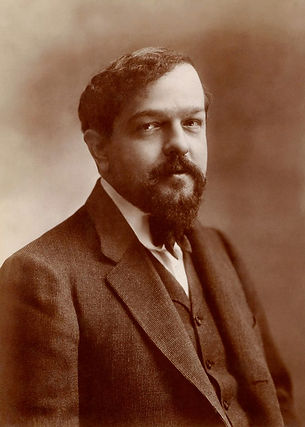
Debussy - a piano story
Claude Debussy, born in 1862 near Paris, rose from modest beginnings to study at the Conservatoire. He traveled widely, absorbing diverse influences, and became a central figure in French cultural life. Known for his independence and innovation, he challenged tradition until his death in 1918, leaving a lasting artistic legacy


Debussy piano works
Claude Debussy’s piano music forms one of the most distinctive and influential bodies of work in the late 19th and early 20th centuries, reflecting his broader artistic vision of color, atmosphere, and innovation. While his entire oeuvre spans orchestral, vocal, and chamber music, the piano remained central to his creative identity, serving as both a laboratory for experimentation and a medium of intimate expression.
Debussy’s piano compositions are remarkable for their departure from traditional harmonic progressions and their embrace of subtle timbres, rhythmic freedom, and evocative imagery. His writing often mirrors the impressionist painters of his time, favoring suggestion over declaration, and creating sound worlds that blur boundaries between harmony and melody. The piano works stand apart as self-contained explorations of mood, texture, and sonority, embodying his lifelong quest to redefine French music against the dominance of Germanic traditions Wikipedia JSTOR.
Among his major piano works, the Suite Bergamasque (1890, revised 1905) remains one of his most beloved collections, with its famous Clair de Lune epitomizing his lyrical style. The Estampes (1903) showcase his fascination with exoticism and atmosphere, with pieces like Pagodes inspired by Javanese gamelan. His Images (two sets, 1905 and 1907) represent some of his most refined piano writing, combining shimmering textures with structural innovation. The Children’s Corner suite (1908), dedicated to his daughter, balances charm with sophistication. Later works such as the Préludes (two books, 1909–1913) and Études (1915) demonstrate his mature style: the Préludes explore fleeting impressions and poetic titles, while the Études push pianistic technique into new expressive realms.
Taken together, Debussy’s piano oeuvre charts a journey from early Romantic influences to radical modernism. It remains a cornerstone of the repertoire, not only for its technical demands but for its unparalleled ability to evoke atmosphere, nuance, and imagination.
Debussy during his life time:
Direct Answer:
Claude Debussy was not celebrated as a virtuoso pianist in his lifetime, but his piano compositions gradually earned recognition, establishing him as one of the most original voices in French music by the early 20th century Wikipedia Britannica World History Encyclopedia Claude Debussy.
Detailed Response (≈200 words)
Claude Debussy’s relationship with the piano was complex. Trained at the Paris Conservatoire, he showed considerable skill as a pianist but never pursued a career as a touring virtuoso. His technique was admired for sensitivity and color rather than brilliance, and he often performed his own works privately or in salons rather than on grand concert stages Wikipedia Claude Debussy. Early in his career, his unconventional harmonic language and rejection of academic rules drew criticism from conservative teachers and audiences, limiting his immediate success Wikipedia.
However, by the turn of the century, Debussy’s piano compositions began to attract attention for their originality. Works such as Suite Bergamasque and later Estampes and Images revealed a new approach to piano writing, emphasizing atmosphere and timbre over traditional virtuosity. His reputation grew further with the publication of the Préludes (1909–1913), which were praised for their poetic imagination. While he never achieved the celebrity status of pianists like Liszt or Chopin, Debussy’s piano music was increasingly performed and admired during his lifetime, especially after the success of his opera Pelléas et Mélisande in 1902 brought him international fame Wikipedia Britannica.
By his death in 1918, Debussy was recognized not as a great pianist, but as a revolutionary piano composer whose works reshaped modern keyboard repertoire.
Sources: Wikipedia Britannica World History Encyclopedia Claude Debussy